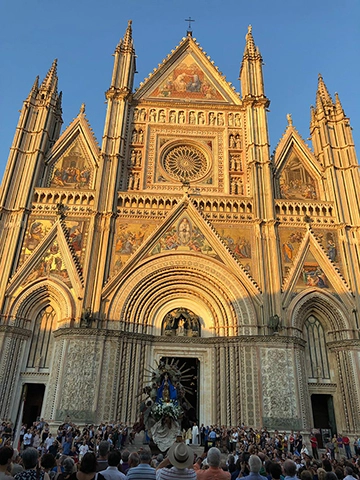
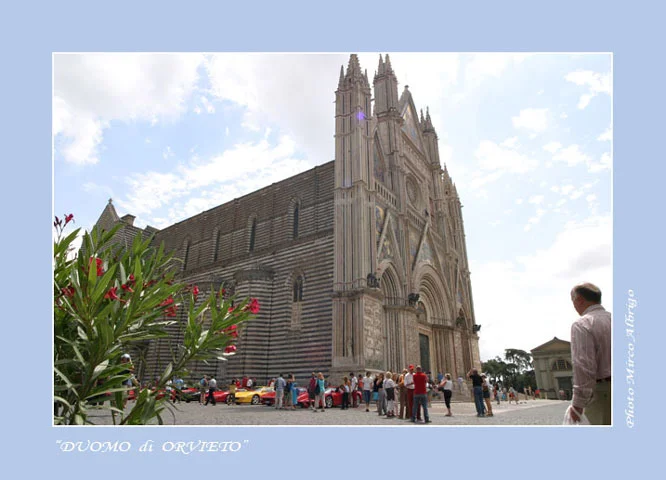
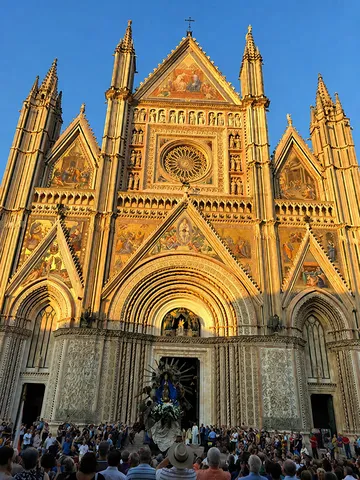
Orvieto Cathedral, dedicated to Santa Maria Assunta, dominates the main square of the historic centre and is one of Umbria’s most recognisable monuments. Its polychrome façade, covered with marble, mosaics, sculptures and bas-reliefs, changes continuously with the light and anticipates the artistic richness preserved inside.
Construction began in 1290, during the period of greatest political and economic prosperity of the medieval commune. Pope Nicholas IV supported the creation of the new cathedral and laid the foundation stone. In the initial phase, the building site was entrusted to Fra Bevignate, documented as head of the Opera, while numerous local and foreign craftsmen took part in constructing the building.
Before 1310, technical and artistic direction passed to Lorenzo Maitani. The Sienese master builder profoundly transformed the project, helping define the three-gabled façade and reinforce the structure. From that moment, the Cathedral became not only a major religious building but also a symbol of the city’s identity and ambition.
The Cathedral’s history is also linked to the memory of the Eucharistic miracle of Bolsena. The Holy Corporal is preserved in the chapel of the same name and remains one of the Cathedral’s principal spiritual references.
The Cathedral façade is not merely its entrance:
it is a story carved in stone and illuminated with gold, introducing
visitors to Orvieto’s religious and artistic history.