The village on the hill
Civita stands on the top of a hill, perched on a rocky spur with its cluster of medieval houses.

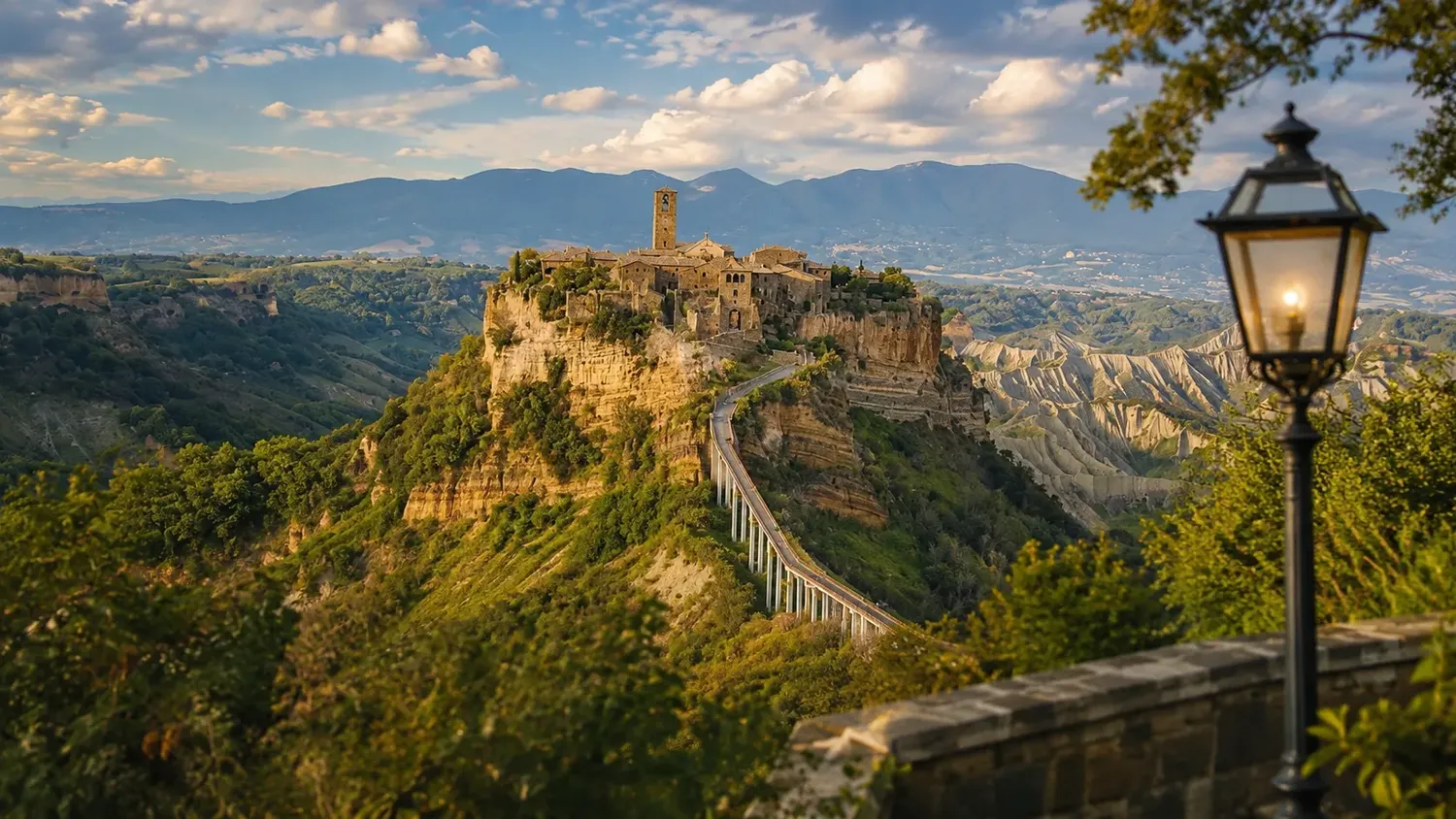
The small village known as “the dying town”, perched on a tuff spur and surrounded by badlands.
Discover the villageA small village in the municipality of Bagnoregio, in the province of Viterbo.
Ancient Bagnorea, now Bagnoregio and the birthplace of Saint Bonaventure, was once connected to Civita by a narrow strip of land. The village’s best-known description was coined by the writer Bonaventura Tecchi, who called it “the dying town”.
Civita di Bagnoregio lies close to the border with Umbria and is known by this name because of the erosion and gradual landslides affecting the tuff rock on which the village was founded. Bagnoregio preserves the Romanesque-Gothic church of Sant’Agostino, the cathedral of San Nicola with its sixteenth-century bell tower, and the Town Hall.
Civita is connected to the mainland by a bridge. The village is home to the Romanesque church of San Donato and the Renaissance palaces of the Colesanti and Alemanni families.
The village, the bridge and the badlands create a particularly striking landscape.
Civita stands on the top of a hill, perched on a rocky spur with its cluster of medieval houses.
Opposite the viewpoint, Civita is connected to the surrounding area by a single narrow bridge approximately 300 metres long.
Around the village lies a broad basin marked by badlands, large erosion formations that define the landscape.
The village seen from the viewpoint, the bridge and the church of San Donato.
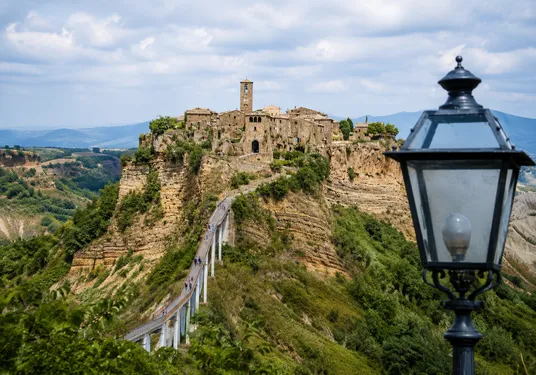
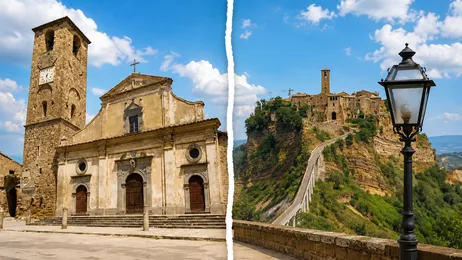
Porta Santa Maria, Piazza San Donato and the village’s main monuments.
As you enter the village, the first important monument you encounter is Porta Santa Maria, topped by a pair of lions clutching two human heads, a symbol of the tyrants defeated by the people of Bagnoregio.
Continuing along Via Santa Maria, you reach the main square, where the Romanesque church of San Donato, remodelled in the sixteenth century, stands. Inside are a fifteenth-century wooden crucifix attributed to the school of Donatello and a fresco from the school of Perugino.
Other treasures of the village include the Romanesque-Gothic church of the Annunziata, the bell tower dating from 1735, the cloister built in 1524 to a design by the architect Michele Sammicheli, the central well created by Ippolito Scalza in 1604, and the cave of Saint Bonaventure carved into the tuff.
The key historical events that shaped the village over the centuries.
The earliest reliable records of Bagnorea, the oldest name for Bagnoregio, date back to the sixth century, when it was listed among the Italian episcopal sees. After the fall of the Roman Empire, it came under the rule of the Goths and Lombards; Charlemagne later granted it to the Papacy. The feudal lords who alternated in power also included the Monaldeschi family, who later became lords of Orvieto.
In the twelfth century, Bagnoregio became a free commune and experienced a period of prosperity and cultural vitality. Although it lay within the sphere of influence of nearby Orvieto, it managed to maintain a degree of independence.
In 1348, a plague epidemic struck the town severely. In 1494, the people of Bagnoregio destroyed the Monaldeschi fortress and opposed the entry of Charles VIII of France, who was travelling towards Naples with his army.
Two years later, Pope Alexander VI Borgia established the rule of cardinal-governors, which lasted until 1612, when Bagnoregio came under the control of the Apostolic Delegation of Viterbo.
In 1695, an earthquake caused serious damage to Civita. A second earthquake in 1794 caused the narrow natural bridge connecting Civita to the settlement of Rhota to collapse. Many inhabitants then left the hill and settled in Rhota, now part of Bagnoregio’s historic centre.
In 1867, the clash between papal troops and Garibaldian volunteers became known as the Battle of Bagnorea. In 1870, Bagnoregio became part of the Kingdom of Italy.
A pleasant day trip from Orvieto, about 25-30 minutes away by car.
From B&B Il Terrazzo, Civita di Bagnoregio can be reached by car by following the signs for Bagnoregio and then for Civita. The journey takes approximately 25-30 minutes.
Once in Bagnoregio, you can leave your car in one of the visitor parking areas, including Piazzale Battaglini, and continue towards the Belvedere and the entrance to Civita.
The final part of the route is on foot, across the characteristic pedestrian bridge that leads directly to the village.
Civita di Bagnoregio is only 18 km from our B&B Il Terrazzo, in a strategic location between Orvieto and the beautiful Lake Bolsena.