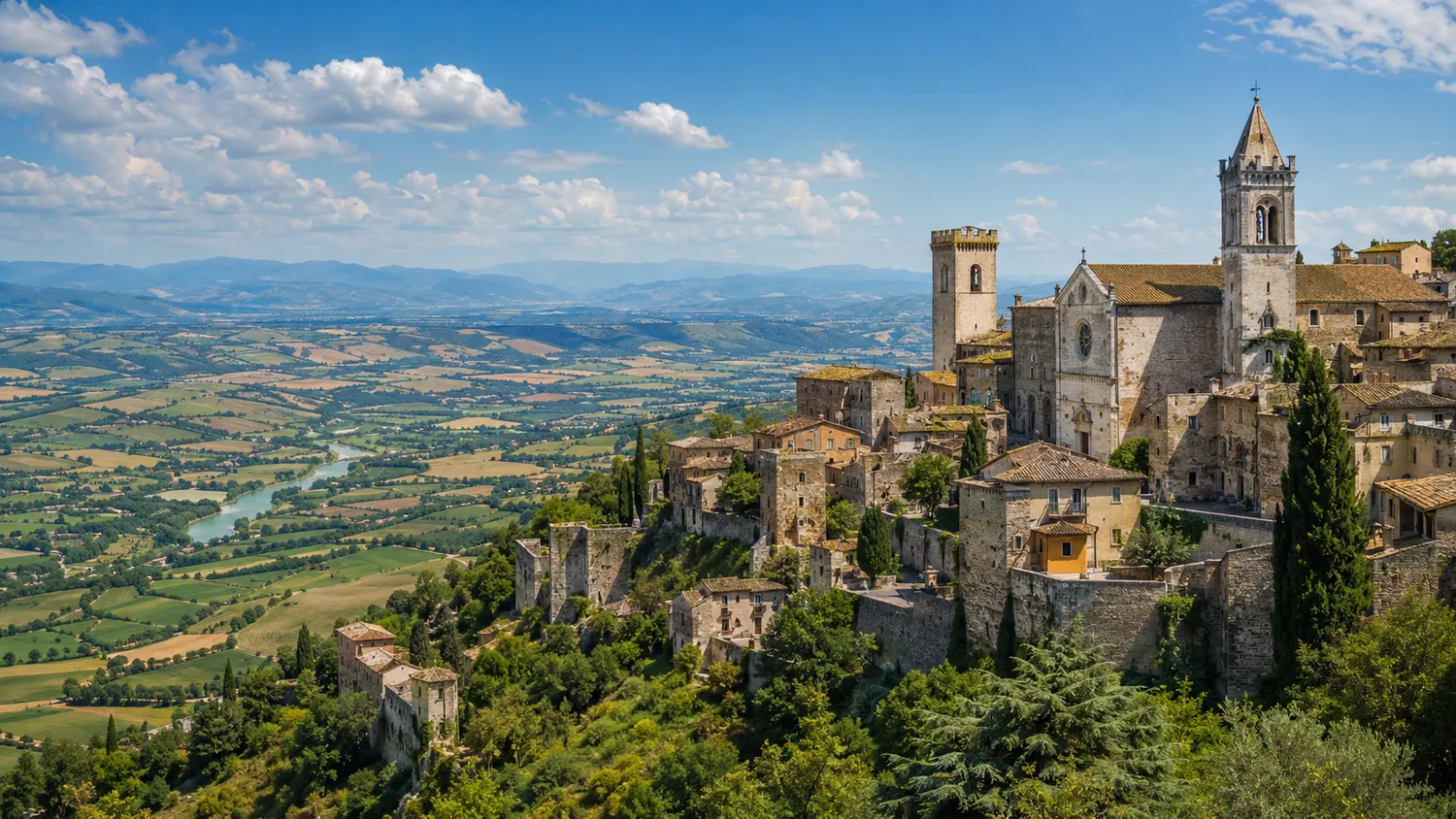
Illustrative view of Todi's historic centre and the Tiber Valley

Todi: what to see when travelling from Orvieto

An art town overlooking the Tiber Valley, with medieval squares, Renaissance architecture and traditional Umbrian flavours.

Discover Todi

From Orvieto to Todi through the Tiber Valley

A scenic journey of approximately 37–40 kilometres, normally taking 40–50 minutes.

From B&B Il Terrazzo, Todi can be reached by following the roads towards the SS 448. For long stretches, the route follows the Tiber and the shores of Lake Corbara, passing through rocky gorges and open countryside.

The journey is worth taking at a relaxed pace. In some places, the river flows between steep rock walls; a little farther on, the landscape opens towards hills, woodland and cultivated fields. It is one of the most scenic routes connecting two important Umbrian art towns.

Todi stands on a hill overlooking the Tiber Valley. Its origins were probably Umbrian; the town later came into contact with the Etruscan world and, during Roman times, became a colony and municipality known as Tuder.

During the Middle Ages, it became a powerful independent commune. The communal period brought the construction of palaces, churches and fortifications, as well as frequent conflicts with nearby towns, including Orvieto, Spoleto and Narni.

Todi retains the intimate character of a medieval town, while also offering broad panoramic spaces from which the eye follows the Tiber and the hills of central Umbria.

A town shaped by several historical periods

The three circuits of walls reflect the town's expansion from the Umbrian and Roman periods through to the Middle Ages. As you climb towards the centre, streets and stairways cross neighbourhoods where civic and religious buildings have overlapped over the centuries.

In the 12th century, Todi became an independent commune and entered a period of considerable development. Many of the buildings that still characterise the historic centre were built or enlarged during this period.

In 1230, Jacopo Benedetti was born in Todi. Better known as Jacopone da Todi, he became one of the most important figures of medieval religious poetry. His tomb is located in the crypt of the Church of San Fortunato.

Approximately 40 km from Orvieto
40–50 minutes estimated journey time
Tuder the Roman name
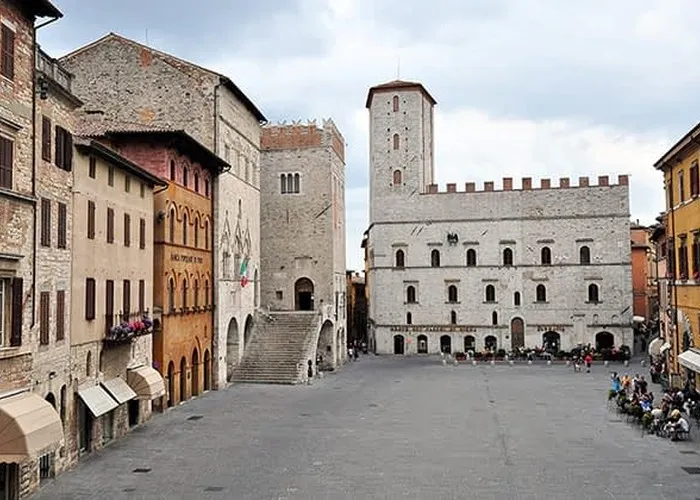
Piazza del Popolo in Todi with its medieval palaces

What to see in Todi

The main monuments can be included in a walking route from Santa Maria della Consolazione to the highest part of the town.

1

Santa Maria della Consolazione

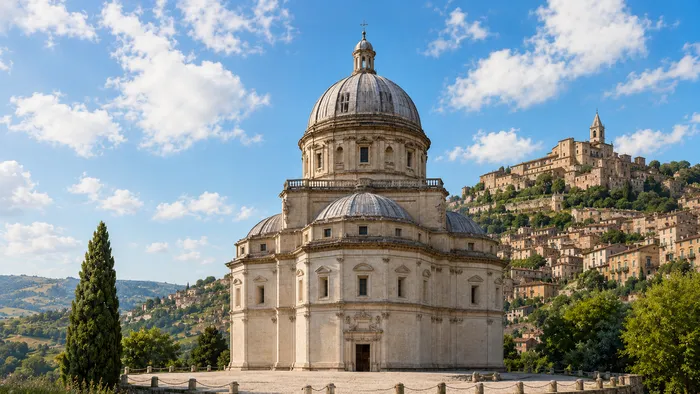
This great Renaissance church stands outside the walls, at the foot of the hill. Construction began in 1508 to house an image of the Virgin that was believed to have brought healing and other graces.

The central plan and dome reflect the Renaissance ideals of balance and perfection. The design is traditionally attributed to Bramante, although the attribution remains debated.

2

Piazza del Popolo

This is the monumental heart of Todi and one of Umbria's most harmonious medieval squares. It is framed by Palazzo del Popolo, Palazzo del Capitano, Palazzo dei Priori and the Cathedral.

Beneath the square lies a system of Roman cisterns, part of the ancient town's complex underground water network.

3

Todi Cathedral

The Cathedral of Maria Santissima Annunziata was begun in the 12th century and enlarged over the following centuries. Its façade is distinguished by a large rose window and a broad staircase.

Inside are the Romanesque apse and the Last Judgement painted on the counter-façade by Ferraù Fenzoni.

4

San Fortunato

The church stands at the top of an imposing staircase and is one of the finest examples of Umbrian Gothic architecture. Work began in 1292 and continued into the 15th century.

The crypt contains the tomb of Jacopone da Todi and the relics of the town's patron saints.

Illustration showing the Temple of Santa Maria della Consolazione at the foot of the hill with the town of Todi above

The Rocca and views over the valley

At the highest point of the town is Parco della Rocca. Only sections of the structures and defensive walls remain of the fortress, which was destroyed in 1503.

Piazzale IV Novembre and the gardens offer wide views across the Tiber Valley, the hills and the countryside south of the historic centre. It is one of the best places to appreciate Todi's strategic position.

The municipal territory was once protected by an extensive network of castles and outposts. One of the most picturesque still remembered is Castello di Montenero, surrounded by pine woodland and overlooking the southern side of the area.

A simple itinerary

Begin at Santa Maria della Consolazione, walk up towards Piazza del Popolo, continue to San Fortunato and finish your walk at Parco della Rocca.

Traditional flavours of Todi

Local cuisine makes use of meat, cured meats, pulses, cereals, unsalted bread, extra virgin olive oil and cheese.

Palomba alla ghiotta

This is one of the most distinctive dishes of Todi's culinary tradition. Palomba, or wild pigeon, is roasted and served with a rich sauce prepared with wine, vinegar, herbs, olives and other ingredients.

It is a historic dish with a bold flavour, now mainly served in restaurants specialising in traditional cuisine.

Other local specialities to try

  • Umbrian cured meats and ham with unsalted bread.
  • Torta al testo or cheese bread with capocollo.
  • Panzanella and flatbreads with rosemary, onion or tomato.
  • Spelt, chickpea and other pulse soups.
  • Polenta with sausage ragù and pecorino cheese.

A detour to Deruta, the town of ceramics

Deruta lies in the central Tiber Valley, approximately 15 kilometres south of Perugia, and is known worldwide for its majolica production. Its artisan tradition, documented since the Middle Ages, reached particular splendour during the 15th and 16th centuries.

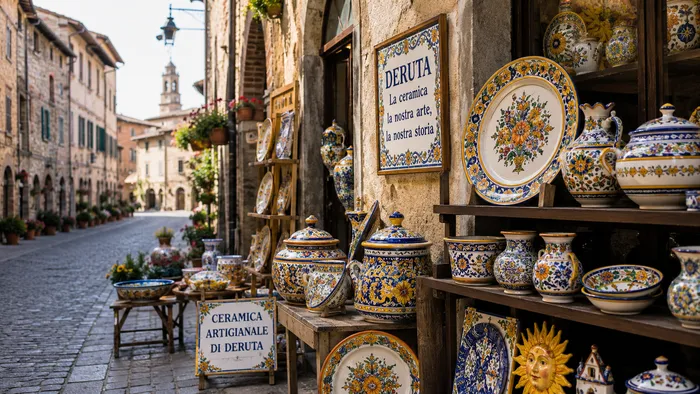
Workshops, signs and decorations throughout the historic centre still reflect this identity. A visit can be combined with a trip to Todi or planned as a separate stop.

Local cuisine also follows Umbrian tradition: tagliatelle with goose sauce, chickpea soup, torta al testo, sausages, beans with pork rind and desserts such as torcolo, often accompanied by vin santo.

Illustrative representation of artisan majolica displayed in Deruta's historic centre

Regional Ceramics Museum

Founded in 1898, it is Italy's oldest museum devoted to ceramics. Housed in the former Convent of San Francesco, it contains more than 6,000 works and documents the development of Deruta majolica from the Middle Ages to the 20th century.

Municipal Art Gallery

The gallery is housed in the 14th-century Palazzo dei Consoli. Its collection includes works by Niccolò di Liberatore, known as L'Alunno, Perugino and other artists active between the Middle Ages and the modern era.

Sant'Antonio Abate

The church contains 15th- and 16th-century frescoes attributed to Bartolomeo and Giovanni Battista Caporali, as well as an 18th-century wooden choir loft.

For up-to-date opening times, consult the official websites of Umbria Tourism – Todi and the Deruta Regional Ceramics Museum.

Visit Todi while staying in Orvieto

A day trip through some of Umbria's most beautiful landscapes.

From B&B Il Terrazzo to the Tiber Valley

B&B Il Terrazzo is a convenient base for visiting Orvieto and planning a day in Todi. After the scenic drive along the SS 448, you can explore the historic centre, taste Umbrian specialities and return to a quiet area at the foot of the Rupe, with free parking and breakfast included.

Frequently asked questions about Todi

How far is Todi from Orvieto?

Todi is approximately 37–40 kilometres from Orvieto. The drive normally takes around 40–50 minutes, depending on traffic and the exact departure point.

What can you see in Todi in one day?

In one day you can visit Santa Maria della Consolazione, Piazza del Popolo, Todi Cathedral, San Fortunato, Parco della Rocca and the main panoramic viewpoints.

Why is Piazza del Popolo important?

It is the monumental heart of the town and brings together Todi Cathedral, Palazzo del Popolo, Palazzo del Capitano and Palazzo dei Priori.

What traditional food can you try in Todi?

Traditional dishes and products include palomba alla ghiotta, Umbrian cured meats with unsalted bread, torta al testo, pulse soups, spelt and polenta with rich sauces.

Is Deruta close to Todi?

Yes. Deruta lies in the central Tiber Valley and can be combined with a visit to Todi, especially for the Regional Ceramics Museum and the artisan workshops.

Is the road from Orvieto to Todi scenic?

Yes. For long stretches, the SS 448 follows the Tiber and Lake Corbara through a landscape of rocky gorges, hills and Umbrian countryside.

Discover Todi from Orvieto

Plan a day among medieval art, views across the Tiber Valley and the flavours of Umbrian tradition.

Book your stay