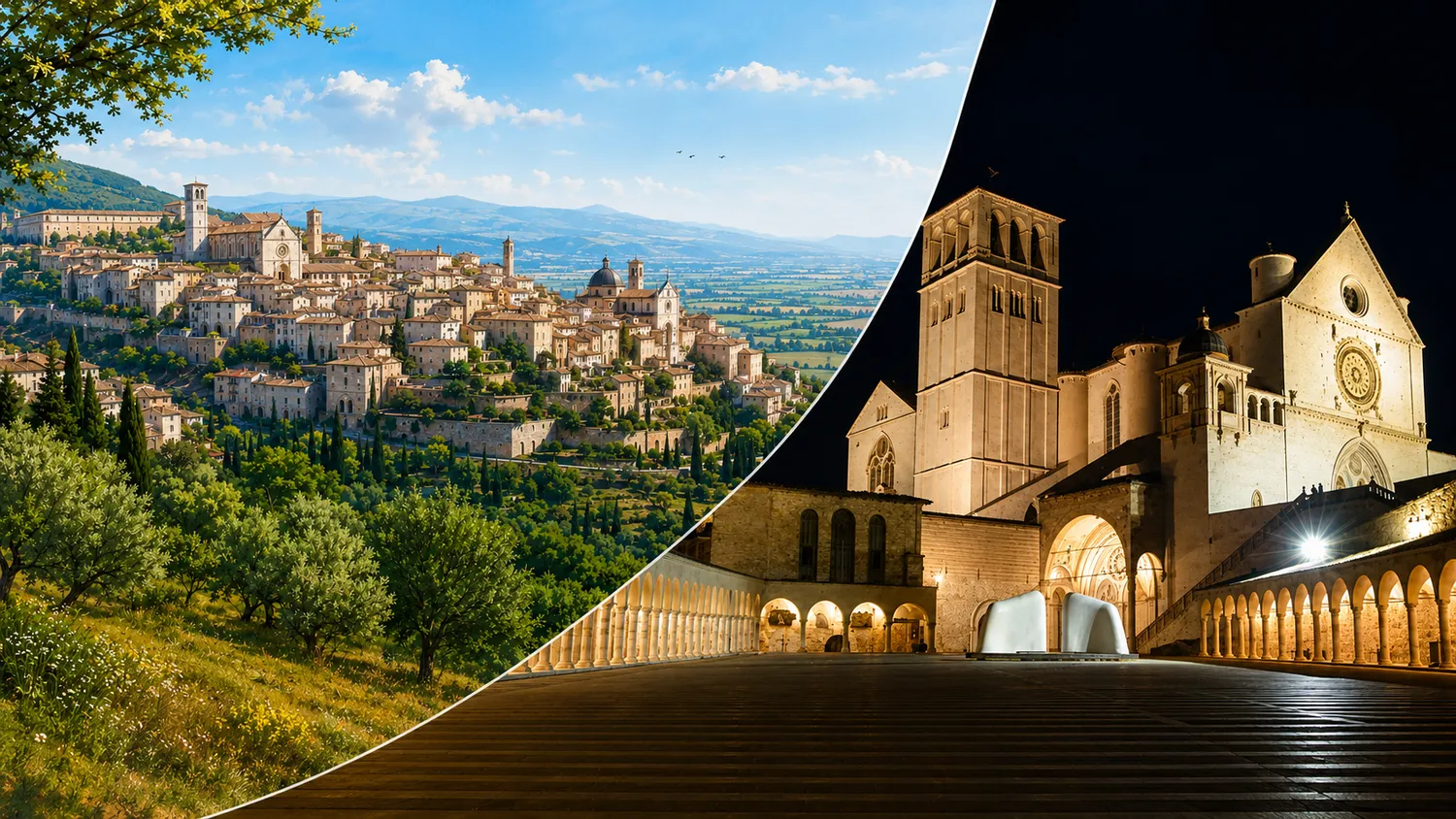
Panoramic view of Assisi with the Basilica of Saint Francis and Mount Subasio

Assisi: what to see when travelling from Orvieto

A town of art and spirituality on the slopes of Mount Subasio, closely linked to the lives of Saint Francis and Saint Clare.

Discover Assisi

Assisi, a town of stone and light

Assisi can be reached from Orvieto by car in approximately one hour and twenty minutes to one hour and thirty minutes.

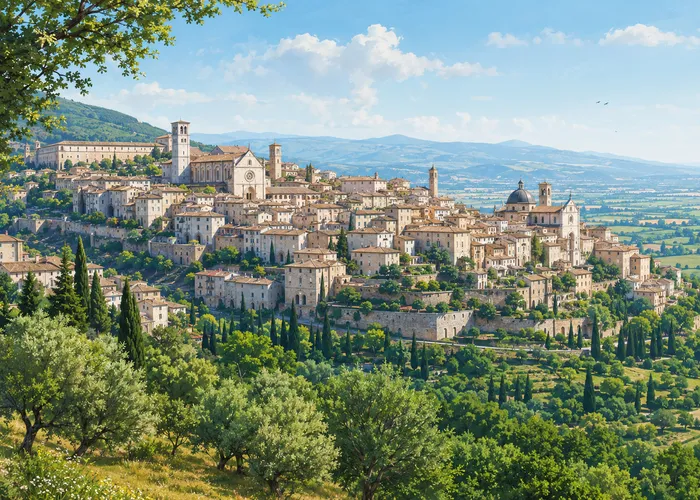
Assisi stretches across the western slopes of Mount Subasio, in a panoramic position overlooking the Umbrian Valley. Houses built from the mountain’s pale pink stone, together with the walls, towers and bell towers, create an immediately recognisable townscape.

The town is known throughout the world as the birthplace of Saint Francis, patron saint of Italy, and Saint Clare. Their legacy has profoundly shaped the identity of Assisi and transformed it into one of Europe’s leading spiritual and cultural destinations.

Walking through Assisi means passing through different periods of history: Roman remains, Romanesque and Gothic churches, medieval palaces, convents and fortifications line its climbing streets, arches and squares overlooking the valley.

Since 2000, Assisi, the Basilica of Saint Francis and the other Franciscan sites have been included on the UNESCO World Heritage List. This recognition encompasses not only individual monuments, but also the relationship between the town, the landscape and the Franciscan legacy.

Assisi combines the grandeur of its basilicas with the simplicity of its lanes, gardens and olive groves descending towards the plain.

An ancient town on the slopes of Mount Subasio

Before becoming a Roman settlement, the area was inhabited by the ancient Umbrians. During the Roman period, the town was known as Asisium and was enriched with walls, cisterns, public buildings and places of worship.

Piazza del Comune still preserves important traces of this past: the Temple of Minerva, later converted into a church, dominates the square together with the Torre del Popolo and the civic buildings.

During the Middle Ages, Assisi developed as an independent commune and became involved in conflicts between the Umbrian towns. The birth of Francis, between 1181 and 1182, however, opened a new chapter in its history, one that would carry the town’s name far beyond the regional borders.

Approximately 85–90 km from Orvieto
1 h 20–1 h 30 approximate driving time
Since 2000 UNESCO World Heritage Site
Medieval historic centre of Assisi seen from the slopes of Mount Subasio

What to see in Assisi

The main monuments can be included in a walking itinerary through the historic centre.

1

Basilica of Santa Chiara

Built in the 13th century, it is recognisable by its façade of alternating white and pink stone and its large flying buttresses. The basilica houses the body of Saint Clare and the San Damiano Crucifix, associated with the calling of Saint Francis.

2

San Rufino Cathedral

The cathedral has one of the most important Romanesque façades in Umbria. Its baptismal font is associated with Saint Francis, Saint Clare and, according to tradition, Frederick II.

3

Piazza del Comune

This is the civic heart of the town. It is overlooked by the Temple of Minerva, the Torre del Popolo, Palazzo del Capitano and Palazzo dei Priori. The square retains the layout of the ancient Roman forum.

4

Rocca Maggiore

The fortress dominates Assisi from above and recalls the military role of the medieval town. Its paths and surrounding areas offer extensive views over the Umbrian Valley and Mount Subasio.

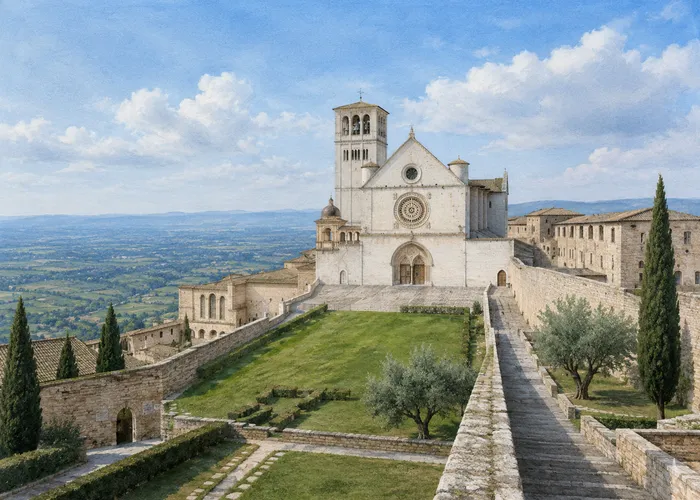
Basilica of Saint Francis in Assisi with the Sacro Convento

The Basilica of Saint Francis

The Basilica was commissioned by Pope Gregory IX shortly after the canonisation of Francis. Construction began in 1228; in 1230 the saint’s body was transferred to the Lower Church, while the Upper Church was completed by 1253.

The complex consists of two churches built one above the other and a crypt containing the tomb of Saint Francis. The architecture follows the slope of the hill and connects spaces with very different characters: intimate and dimly lit in the lower section, taller and brighter in the upper section.

The frescoes by Cimabue, Pietro Lorenzetti, Simone Martini, Giotto and their respective workshops make the Basilica one of the essential places for understanding the development of Italian painting between the 13th and 14th centuries.

Upper Church

The Gothic interior is tall and bright, with large windows. Its walls display biblical scenes and the celebrated cycle of the Stories of Saint Francis, traditionally attributed to Giotto and his workshop, although the attribution continues to be debated by scholars.

The cycle tells the story of the saint’s life through scenes marked by a new attention to space, gestures and human emotions.

Lower Church and tomb

The Lower Church has lower naves and a more intimate atmosphere. Its chapels and vaults are decorated with important fresco cycles, including works by Giotto and his workshop, Simone Martini and Pietro Lorenzetti.

From the church, visitors descend to the crypt, where the tomb of Saint Francis consists of a simple stone sarcophagus set within the central pillar.

The Basilica is first and foremost a place of worship. For opening times, religious services, group access and up-to-date information, please consult the official website of the Basilica of Saint Francis.

Other Franciscan sites

To truly understand Assisi, it is worth spending a few hours away from the main monumental route.

San Damiano

This small convent among the olive trees is associated with the conversion of Francis and the life of Saint Clare. It preserves a simple, intimate atmosphere, very different from the grandeur of the basilicas.

Eremo delle Carceri

It lies in the woods of Mount Subasio, a few kilometres from the town centre. Francis and his companions withdrew here to pray in silence among caves, paths and holm oaks.

Santa Maria degli Angeli

On the plain below Assisi, the large basilica houses the Porziuncola, the small church beloved by Francis, and the Chapel of the Transito, associated with the final moments of his life.

The flavours of Assisi and Umbria

Simple cuisine based on high-quality ingredients and rural traditions.

Starters and local products

  • Umbrian cured meats, capocollo and prosciutto.
  • Pecorino and other local cheeses.
  • Filled torta al testo flatbread.
  • Bruschetta with extra virgin olive oil.

First courses and traditional dishes

  • Strangozzi pasta with truffles or rich sauces.
  • Soups made with spelt, chickpeas and lentils.
  • Roast and grilled meats.
  • Game dishes on traditional menus.

Olive oil and wine

The local olive groves produce a highly regarded extra virgin olive oil. In restaurants, it can be paired with Umbrian wines, including those produced around Assisi, Montefalco and Spello.

Tips for a day trip from Orvieto

Assisi can be visited in a day, but an early start and good planning are recommended.

Essential itinerary

  • Basilica of Saint Francis.
  • Piazza del Comune.
  • Santa Chiara and San Rufino.
  • Rocca Maggiore, if time allows.

How to prepare

  • Wear comfortable shoes: the historic centre has steep streets and uneven paving.
  • Respect the silence and rules in places of worship.
  • Check access, parking and opening times before setting out.

With more time

  • San Damiano.
  • Eremo delle Carceri.
  • Santa Maria degli Angeli and the Porziuncola.
  • A stop in Spello during the journey.

A day between Orvieto and Assisi

By leaving the B&B early, you can reach Assisi in the morning, spend the first part of the day at the Basilica of Saint Francis, then walk through the historic centre and finish your visit at Santa Chiara or Rocca Maggiore before returning.

For up-to-date information about monuments, events and transport, consult the official tourism portal: Umbria Tourism – Assisi.

Visiting Assisi while staying in Orvieto

A day trip between two of Umbria’s most important historic towns.

From B&B Il Terrazzo to the town of Saint Francis

B&B Il Terrazzo is a peaceful base for visiting Orvieto and planning a day trip to Assisi. After travelling through Umbria, you can return to the foot of the Orvieto cliff, leave your car in the free parking area in front of the property and relax in rooms suitable for couples and families, with breakfast included.

Frequently asked questions about Assisi

How far is Assisi from Orvieto?

Assisi is approximately 85–90 kilometres from Orvieto. The drive normally takes around one hour and twenty minutes to one hour and thirty minutes, depending on the route and traffic.

What can you see in Assisi in one day?

In one day you can visit the Basilica of Saint Francis, Piazza del Comune, Santa Chiara, San Rufino Cathedral and Rocca Maggiore, while still leaving time to walk through the historic centre.

Is the Basilica of Saint Francis made up of two churches?

Yes. The complex includes the Lower Church, which has a more intimate atmosphere and is connected to the tomb of Saint Francis, and the Upper Church, which is bright and renowned for its important fresco cycles.

Where is the tomb of Saint Francis?

The tomb is located in the crypt beneath the main altar of the Lower Church.

Is Assisi a UNESCO World Heritage Site?

Yes. Since 2000, Assisi, the Basilica of Saint Francis and the other Franciscan sites have been included on the UNESCO World Heritage List.

What should you try in Assisi?

Local specialities to try include Umbrian cured meats, cheeses, torta al testo, pulses, strangozzi pasta, roast meats, extra virgin olive oil and local wines.

Discover Assisi from Orvieto

Plan a day of medieval art, spirituality, Umbrian landscapes and places associated with the life of Saint Francis.

Book your stay