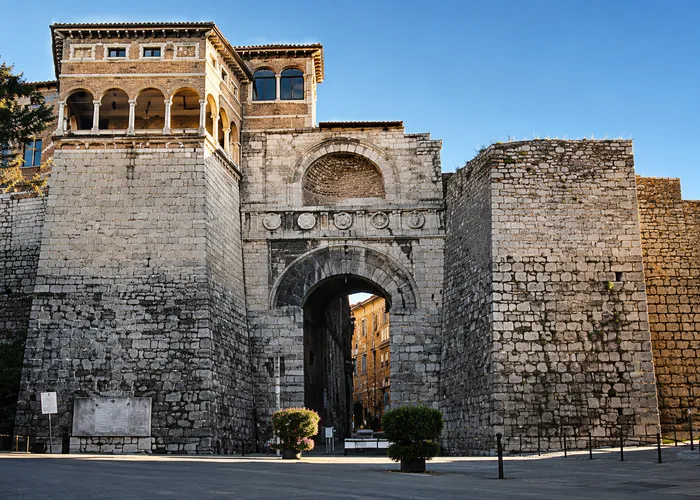
Etruscan Arch or Arch of Augustus
It is the most imposing gate in the Etruscan city walls. It was monumentalised in the 3rd century BC and restored after the Perusine War, when it received the inscription Augusta Perusia.
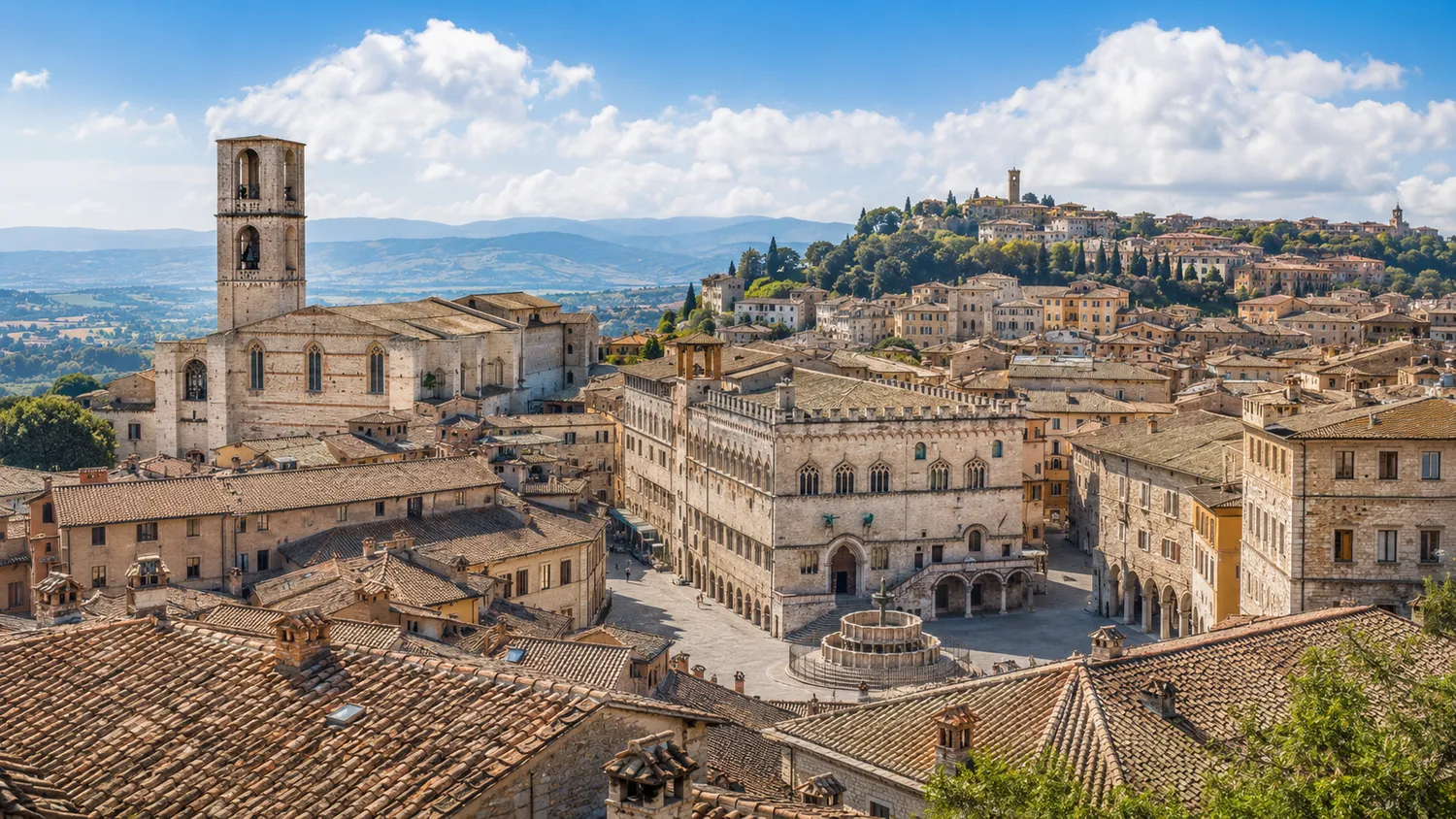
The capital of Umbria, with Etruscan walls, medieval palaces, museums, music and food traditions.
Discover PerugiaA route of approximately 75–80 kilometres through the Umbrian countryside.
Perugia, the capital of Umbria, can be reached from Orvieto by car in approximately one hour and ten minutes to one hour and twenty minutes, depending on traffic and the chosen route.
From B&B Il Terrazzo, take a short section of the SS 205 and continue along the SS 448, a scenic road that follows Lake Corbara and the Tiber valley. After Todi, join the E45 towards Perugia.
The journey crosses one of Umbria’s most characteristic landscapes: rocky cliffs, river bends, woodland, hills and cultivated fields lead towards the large city spread across the high hills to the right of the Tiber.
Perugia brings together many aspects of the region: Etruscan history, medieval architecture, art, universities, craftsmanship, music and food. Since 1925, the University for Foreigners has also contributed to the city’s international and multicultural character.
Perugia has ancient origins. Between the 7th and 6th centuries BC, the city became one of the most important centres of Etruria, protected by a powerful wall approximately three kilometres long.
In 41 BC, during the conflict between Octavian and Lucius Antonius, Perugia was involved in the Bellum Perusinum. After the destruction and fire, Augustus promoted a period of reconstruction. The inscription Augusta Perusia on the Etruscan Arch dates from this time.
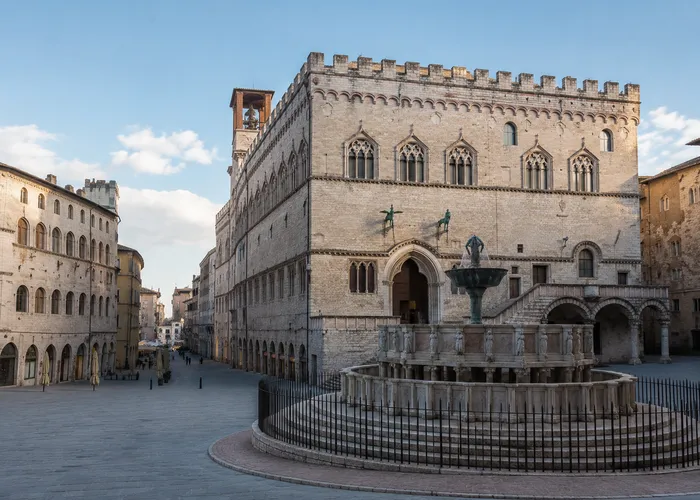
In the Middle Ages, Perugia became a powerful independent commune. Piazza IV Novembre, Palazzo dei Priori and Fontana Maggiore still bear witness to the political and artistic prosperity achieved during the 13th and 14th centuries.
Perugia’s heritage allows visitors to explore more than two thousand years of history along an almost entirely pedestrian itinerary.
It is the most imposing gate in the Etruscan city walls. It was monumentalised in the 3rd century BC and restored after the Perusine War, when it received the inscription Augusta Perusia.
Porta Marzia, another important Etruscan gate from the 3rd century BC, was dismantled and rebuilt into the façade of Rocca Paolina, the fortress commissioned by Pope Paul III and constructed between 1540 and 1543 to a design by Antonio da Sangallo the Younger.
A symbol of Perugia, it was built in the 13th century as part of the city’s new aqueduct. The project is associated with Fra Bevignate, while the sculpted decorations were created by Nicola and Giovanni Pisano.
The great Gothic palace houses the city council, the Sala dei Notari and the National Gallery of Umbria, which preserves major works of Umbrian and Italian art, from the Middle Ages to the Renaissance.
The cathedral overlooks Piazza IV Novembre with its unfinished side clad in pink and white stone. Inside are paintings, sculptures, chapels and important evidence of the city’s religious history.
Also known as the Sorbello Well, it is a major hydraulic structure from the 3rd century BC, excavated beneath the acropolis. The visit allows you to see the Etruscan structures that guaranteed the city’s water supply.
In addition to its best-known monuments, Perugia preserves churches and religious complexes of great interest. The Church of the Gesù is famous for its richly carved and gilded ceiling and its underground rooms; the Basilica of San Pietro, founded in the 10th century, houses an important collection of works of art.
Corso Vannucci connects Piazza IV Novembre with Piazza Italia and is the city’s main promenade. From here you can reach Rocca Paolina, the viewpoints and the escalators connecting the upper city with the districts below.
The city has a very strong relationship with the surrounding landscape. From the Carducci Gardens, Porta Sole and the streets overlooking the walls, you can admire the Umbrian Valley, the Apennine hills and the countryside surrounding the urban centre.
You can begin at the Etruscan Arch, descend towards Piazza IV Novembre, visit Palazzo dei Priori and the National Gallery, then walk along Corso Vannucci to Rocca Paolina.
Perugia’s cuisine uses simple, flavourful ingredients linked to the countryside, traditional pork products and local festivals.
Ciaramicola is an Easter ring cake with a distinctive red dough, covered with white meringue and coloured sprinkles.
Pinoccate are small diamond-shaped sweets made with sugar and pine nuts, traditionally white or flavoured with cocoa.
This cake is associated with the feast of Perugia’s patron saint, celebrated on 29 January. It has a ring shape and is made with raisins, candied fruit, pine nuts and aniseed.
According to tradition, young women also offered torcolo to their sweethearts.
Dates change every year, so before travelling it is advisable to check the official event programmes.
Founded in 1973, it is one of Europe’s best-known jazz festivals. It usually brings Perugia to life in July with concerts in theatres, squares and at the Arena Santa Giuliana.
Official Umbria Jazz programmeThe festival dedicated to cocoa and chocolate transforms the historic centre into a large route among producers, tastings, installations and cultural initiatives. It is traditionally held in autumn.
Official Eurochocolate websiteFounded in 1937, it is one of Italy’s oldest festivals dedicated to sacred and spiritual music. Concerts and meetings take place in Perugia and other historic locations across Umbria.
Sagra Musicale UmbraThe International Festival of Animated Figures offers puppet shows, object theatre, workshops and creative activities aimed especially at children and families.
Information about FigurateviThe presence of the University of Perugia and the University for Foreigners makes Perugia a young, multilingual city full of meetings, conferences, exhibitions and cultural initiatives throughout the year.
University for ForeignersThe National Gallery of Umbria, Palazzo Baldeschi, the archaeological museum and municipal venues host permanent collections and temporary exhibitions.
Discover PerugiaPerugia can be visited in a day, but the historic centre requires several hours and includes climbs, descents and underground routes.
For up-to-date information about monuments, museums, transport and events, consult the Umbria Tourism – Perugia e l' Municipal tourist information point.
A trip between two art cities through the Tiber valley.
B&B Il Terrazzo is a peaceful base for visiting Orvieto and organising a day in Perugia. After the scenic journey along Lake Corbara and the Tiber valley, you can explore the historic centre and return to the foot of the cliff, with free parking in front of the property and breakfast included.
Perugia is approximately 75–80 kilometres from Orvieto. By car, the journey normally takes about one hour and ten minutes to one hour and twenty minutes, depending on the route and traffic.
In one day you can visit the Etruscan Arch, Piazza IV Novembre, Fontana Maggiore, San Lorenzo Cathedral, Palazzo dei Priori, the National Gallery of Umbria and Rocca Paolina.
Yes. Perugia became one of the main centres of Etruria and still preserves important walls, monumental gates and underground structures of Etruscan origin.
The best-known events include Umbria Jazz, Eurochocolate, the Sagra Musicale Umbra and the Figuratevi International Festival of Animated Figures.
Foods and dishes to try include torta al testo, Umbrian cured meats, cheeses, truffles, Easter cheese bread, ciaramicola, pinoccate and torcolo di San Costanzo.
Yes. The route along the SS 448 follows Lake Corbara and the Tiber before reaching Todi and joining the E45.
Plan a day among Etruscan history, medieval art, museums, music and traditional Umbrian flavours.
Book your stay