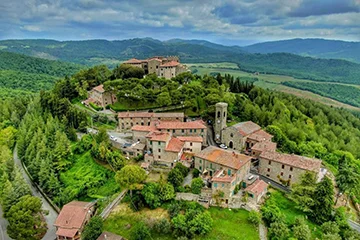
Panoramic view of Orvieto and the surrounding villages.

What to see in Orvieto and surroundings

The municipalities of the Orvieto area

Mobile: +39 347 0385659
Orvieto area

The Orvieto area is rich in history, atmosphere and beautiful landscapes. By staying at our accommodation, you can easily reach some of the most charming villages in the area, including...

Below you will find descriptions of the municipalities that are part of the Orvieto area.

Discover the villages of the Orvieto area

Medieval village of Montegabbione near Orvieto

What to see in Montegabbione

It stands on a hill of the pre-Apennine range at 594 metres above sea level, in a strategic position: roughly equidistant from Rome and Florence (about 150 km), from Orvieto and Perugia (about 40 km), and from Lakes Bolsena and Trasimeno (about 60 km). Finds from the Etruscan and Roman periods suggest very ancient origins. Historically, the area preserves, with the exception of the more recent hamlet of Faiolo, a system of fortified strongholds still visible in the castles of Montegiove, Casteldifiori and Montegabbione itself. The village is enclosed by solid medieval walls that contain an orthogonal urban layout, with the square at the centre and the protection of watchtowers and the castle. Around 1300 Montegabbione was a fief of the Monaldeschi family of Orvieto. After the period of Ugolino di Montemarte, in 1380 it came under the rule of Perugia. Outside the walls you can admire the Church of Madonna delle Grazie, built in 1625 on an earlier chapel, and, not far from the village, the ruins of the Abbey of Aqualta and the Franciscan convent of La Scarzuola, alongside the fantastic architecture of Tommaso Buzzi. The surroundings of Montegabbione are also rich in landscape beauty and natural resources, traditionally linked to agriculture and livestock farming, with particular development in meat processing. Among the most popular events is ā€œSapore d’anticoā€, an art and craft market held in the streets of the historic centre.

Scarzuola
Reachable in just 35 minutes by car from B&B Il Terrazzo
View of the medieval village of Parrano with the castle

What to see in Parrano

About 40 km from Orvieto, Parrano is a picturesque and well-preserved historic centre. Surrounded by the green heart of the woods and reached by a road that reveals unforgettable views, Parrano still lives today in an atmosphere that seems to have stopped time. Its 11th-century castle is the centre of the village and still preserves its walls, arches and squares. The ā€œCastrum Parraniā€ was built around the year 1000 and, under the rule of Orvieto, took part in the struggles of the medieval period. In the 15th century it became part of the Papal State, like all the small towns in the area. The name Parrano seems to derive from ā€œparraā€, the Latin word for the hoopoe, the beautiful bird with a colourful crest that inhabits the woods of these areas. In the nearby ā€œTane del Diavoloā€, ravines and deep caves of great interest to speleologists, important prehistoric finds from the Upper Palaeolithic and Bronze Age have been discovered. From later periods there are still clear traces of Etruscan settlement, with finds from the 6th century BC, and Roman presence. The exhibits in the Territorial Documentation Centre of Parrano include the grave goods of an Etruscan tomb and a section dedicated to the 1500 Statute, an important document for local history. Parrano is mainly an agricultural village, where vines and olive trees are the main crops, but it is also a tourist centre known for its sulphur-magnesium springs, useful for drinking-water treatments. Among the most interesting events is the exhibition-contest ā€œIl Presepeā€.

The Devil’s Caves
Reachable in just 30 minutes by car from B&B Il Terrazzo
Medieval village of Fabro in Umbria

What to see in Fabro

Fabro lies 28 km from Orvieto, on a hill overlooking the Autostrada del Sole between Rome and Florence, in a strategically attractive position for tourism. Within just a few kilometres, it is easy to reach towns of considerable cultural interest. It is a historic centre built around a medieval fortification. The ancient castle, mentioned in the Diplomatic Code of the city of Orvieto in 1259 as ā€œCastrum Fabriā€, is the defining element of the town, although it has undergone many deep architectural changes over the centuries. In the parish church dedicated to Saint Martin, there is a fine wooden bas-relief from 1930, carved in Val Gardena and depicting Saint Martin, Bishop of Tours. The town has developed mainly in the lower area, about 5 km away, near the Autostrada del Sole exit, where a large industrial and craft area has been built, also hosting trade-fair activities. Every year, in mid-November, an important National Truffle and Agricultural Products Market Exhibition is held here. On a nearby hill stands the hamlet of Carnaiola, interesting for its ancient medieval castle, further fortified in the 16th and 17th centuries, when it belonged to the noble Filippeschi and Marsciano families. In addition to wine and olive oil production, typical of the Orvieto area, the gathering of white truffles is among the secondary activities of Fabro’s inhabitants, although in recent years the processing and marketing of this product have developed significantly.


Reachable in just 25 minutes by car from B&B Il Terrazzo
View of Monteleone di Orvieto between Umbria and Valdichiana

What to see in Monteleone di Orvieto

About 45 km from Orvieto, at an altitude of around 500 metres above sea level, Monteleone di Orvieto lies on the hills that separate the Orvieto area from CittĆ  della Pieve. Large green areas are an important attraction: from the main settlement you can overlook the Valdichiana and admire the Tuscan hills sloping down towards Umbria. It was probably because of this natural position that, shortly after the year 1000, the ancient people of Orvieto chose Monteleone to protect their northern borders. Of the original settlement, enclosed within granite walls, only the old Torre Mozza remains today, guarding the entrance gate to the village. The medieval town centre is characterised by the widespread use of brick and preserves a considerable historical and artistic heritage. Of particular interest are the works of art kept in the Collegiate Church and in the Church of the Holy Crucifix. Among the events organised in the village, the traditional ā€œRimpatriataā€ is especially interesting, occupying almost the whole month of August with festivals and celebrations of a cultural, musical and historical re-enactment nature. The historical parade with the challenge between the Montemarte and Marsciano families, ancient owners of the castle, takes place on 16 August. During the Christmas period, the ā€œLiving Nativity Sceneā€ is staged again, involving all the citizens in the historical reconstruction of Bethlehem 2,000 years ago. The village also has a large modern gymnasium and the historic ā€œTeatro dei Rusticiā€, built in 1732, recently restored and now the centre of many activities.


Reachable in just 35 minutes by car from B&B Il Terrazzo
Landscape of San Venanzo on the slopes of Monte Peglia

What to see in San Venanzo

On the slopes of Monte Peglia, about 40 km from Orvieto, San Venanzo is the village in the Orvieto area closest to the territory of Perugia. The first settlements date back to the Palaeolithic, Neolithic, Bronze and Iron Ages, as confirmed by finds now preserved in the Archaeological Museum of Perugia. The Etruscans also left significant traces of their presence. The particular geographical position of this area, between Orvieto, Perugia and Todi, was one of the main causes of numerous local wars during the communal period. The small medieval centre, built before the year 1000 around a shrine dedicated to the patron saint, belonged to the Monaldeschi family and suffered the effects of the struggles between the different branches of that family. Only some elements of the ancient castle remain, incorporated into the villa that is now the town hall, built by the Faina family in the 19th century. Interesting sights include the first remains of the Church of San Venanzo, clearly visible in the public park, and, inside the town hall, mural paintings and decorations. Of significant artistic value is the 14th-century fresco of the Madonna Liberatrice in the church of the same name. The volcanic nature of the ground on which the village stands is of particular geological interest, as shown by the presence of a unique material called ā€œvenanziteā€. Recently a volcanological museum and a nature trail through the lava flow have been created. In the municipal area you can admire the ancient medieval castles of San Vito in Monte, where there is a spring of oligomineral water, Civitella dei Conti, Ripalvella, Collelungo, where the Sanctuary of Madonna della Luce is located, Poggio Aquilone, Pornello and Rotecastello. At 800 metres above sea level, Ospedaletto is the main tourist attraction, with pine woods, parks and a wildlife reserve. In the ā€œSette Fratiā€ park, equipped for picnics and open-air musical events, a service area and a naturalistic documentation centre have been set up, often visited by educational tourism.


Reachable in just 50 minutes by car from B&B Il Terrazzo
Medieval village of Ficulle among the hills of the Orvieto area

What to see in Ficulle

Ficulle is a medieval village set on a ridge and surrounded by the green mountains around it. The motorway passing just a few kilometres away has not changed the life of its inhabitants: there are no frantic rhythms here, only clean air, agriculture, craftsmanship and genuine food, all protected by ancient walls enclosing a maze of alleys and small squares, with old houses still defended by two medieval strongholds. The entire village is a ā€œmonumentā€, with fine works such as the Church of Santa Maria Vecchia, built around 1200, which has a beautifully crafted Gothic portal and important frescoes from the second half of the 15th century, the Church of Santa Maria Nuova and the medieval complex of Castel Maggiore. Not far from the village stands the Castello della Sala, a typical example of 12th-century medieval architecture and once a fief of the Monaldeschi. The symbol of Ficulle is earthenware: domestic objects made of clay, turned on the wheel and fired in a wood oven. These terracotta objects, before the arrival of plastic, marked everyday life. Plates and pots, ā€œpanateā€ and ziri are still produced today, recalling ancient customs and preserving, in their shapes and colours, a local tradition also found in the simple and tasty cuisine. The hospitality of the people of Ficulle is expressed today through welcoming agritourism businesses and a rest area equipped with ecological services for camper travellers. During the year, several cultural events take place, including the ā€œFesta di primaveraā€, a series of recreational and cultural events surrounding the traditional Cantamaggio of Ficulle.


Reachable in just 30 minutes by car from B&B Il Terrazzo
Historic centre of Allerona near Orvieto

What to see in Allerona

Allerona, of Roman or pre-Roman origin, is 20 km from Orvieto and lies picturesquely on a hill at 420 metres above sea level. Of Allerona, once a feudal castle, the remains of the ancient walls, the two gates known as ā€œdel Soleā€ and ā€œdella Lunaā€, and the urban layout still survive. Inside the village, at the highest point, stands the old 12th-century castle church, restored at the end of the last century, with paintings in the apse by the Sienese artist Arturo Viligiardi (1896). Villalba and Selva di Meana, on the borders between Tuscany, Umbria and Lazio, are the two most important tourist areas: the first for its equipped public park and the second for the state-owned park with Villa Cahen, in Liberty style. The clay quarries near the hamlet of Scalo are an interesting site for fossil finds. Crossing the public park of Villalba, you reach the ancient village of San Pietro Aquaeortus, now uninhabited, and descend towards Fabro through Osteriaccia, along a route winding through Mediterranean scrub. The most characteristic festival in Allerona is that of Sant’Isidoro, patron saint of the countryside, held on the third Sunday of May, with a historical parade in 19th-century costumes presenting the so-called ā€œpugnaloniā€, small allegorical carts depicting scenes of rural life. The patron saint of the village is Saint Anzano, solemnly celebrated on the second Sunday of May.


Reachable in just 20 minutes by car from B&B Il Terrazzo
Village of Porano with a view towards the Rupe of Orvieto

What to see in Porano

Porano is situated on a hill facing the Rupe of Orvieto, offering one of its most evocative views. Its territory borders Orvieto and the province of Viterbo. The historic centre, at 444 metres above sea level, preserves the typical appearance of a fortified medieval village, with walls and towers. Not far from the medieval village are two splendid buildings: Castel Rubello and Villa Paolina. Castel Rubello is an impressive 13th-century fortified complex consisting of several buildings and towers. Villa Paolina, which belonged to the Gualterio family, dates back to the 17th century and is surrounded by a beautiful historic park. In the 19th century, Filippo Antonio Gualterio lived there, a leading figure of the Italian Risorgimento and later minister of the Kingdom of Italy. Today the villa houses the scientific research laboratories of the CNR Institute of Agro-environmental and Forest Biology, and every year the park hosts a prestigious national horse show, an international dog show and various cultural events. Numerous archaeological finds have been brought to light in the Porano area; among the most important are the Etruscan tombs (4th century BC): the Hescana tombs in the Molinella Necropolis and the two Golini tombs in the Settecamini Necropolis. The frescoes from the latter are displayed in the National Archaeological Museum of Orvieto. Also worth noting is the Church of San Biagio, built between the 14th and 15th centuries, with frescoes inside depicting the Annunciation and Saint Bernardino. Its location and climate make Porano an elegant residential area and climatic tourist centre.


Reachable in just 15 minutes by car from B&B Il Terrazzo
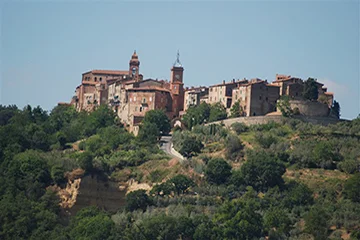
Village of Castel Viscardo near Orvieto

What to see in Castel Viscardo

Located 15 km from Orvieto and 507 metres above sea level, Castel Viscardo owes its development to the presence of the ancient castle of the Dukes of Montevecchio, which until the 16th century was a stronghold of the Monaldeschi family and later a fief of the Spada princes. Among the tourist attractions is the 17th-century Church of San Bartolomeo, whose high altar holds an ivory crucifix donated by Louis XIV to Cardinal Spada, nuncio in Paris. In recent times, an interesting archaeological area has been discovered in the Caldane locality, where an Etruscan necropolis once stood, dating, according to the first investigations, to the 6th century BC. On the nearby Alfina plateau, in 1936, an airport was built with hangars designed by Pier Luigi Nervi, who used a ribbed reinforced-concrete structure for the first time. After the hangars were demolished at the end of the world conflict, the airport was closed and today, not far away, there is an airfield for tourist and sports activities with gliders and small motor aircraft. Of particular interest are the old handmade brick kilns located near the town centre, a true rarity in the field of manufacturing, producing highly sought-after quality products. Among the four hamlets of the municipality, Monterubiaglio and Viceno originated from two medieval strongholds, around which settlements developed over time. The Castle of Monterubiaglio, also belonging to the Monaldeschi family, was recorded in 1292, strengthened in the 14th century and has a statute dated 1611. The patron saint of Castel Viscardo is Saint Anthony of Padua, celebrated on 27 August, and during the August festivities the ā€œSagra della Cannellettaā€ is also held.


Reachable in just 15 minutes by car from B&B Il Terrazzo
Landscape of Castel Giorgio on the Alfina plateau

What to see in Castel Giorgio

Castel Giorgio is the natural main centre of the Alfina plateau: a link between Umbria, Lazio and Tuscany, not far from the slopes of Monte Amiata and just a few kilometres from Lake Bolsena. The village owes its origins to the Bishop of Orvieto, Giorgio della Rovere. In 1477 he had the castle built, which took its name from him, and around it he moved a colony of farmers from his native Parma. The presence of a military airport and an aviation school contributed, around the middle of the last century, to more recent development, including building expansion. Today, mainly agricultural in character, it has an important tourist element in its climatic position, which encourages an alternative type of holiday to the sea or mountains. Particularly interesting are the archaeological remains from the Etruscan and Roman periods, including traces of the consular roads Cassia and Traiana Nova, and the historic residences: from the Castle of Montalfina with its farming village to villas in areas with evocative names such as Montiolo, Fagiolo and Pecorone. Beneath a large part of the municipal area there is significant endogenous activity, visible through surface fumaroles, for which exploitation is planned. The village still preserves many of the rural festivals of the past, the most evocative of which is the feast of the patron saint, Saint Pancras, on 12 May. For at least four centuries this has been accompanied by the fascinating tradition of the ā€œmaggioā€, performed in two stages: the raising and carrying of a wooden pole about twenty metres high according to an ancient ritual.


Reachable in just 20 minutes by car from B&B Il Terrazzo
Village of Montecchio between Orvieto and the Tiber valley

What to see in Montecchio

Montecchio lies 25 km from Orvieto, beyond the Tiber, below Monte Croce di Serra (999 metres above sea level), from which on the clearest days you can glimpse the first urban settlements of Rome on one side and Todi and Assisi on the other. The village, one of the best preserved in the Orvieto district, has an interesting history brought to light by recent excavations in the pre-Roman necropolis of San Lorenzo and the Copio tombs, dating back to the 7th-6th centuries BC, now accessible through a nature trail. The necropolis, set in a natural setting, consists of chamber tombs with typically Etruscan features due to the proximity of Orvieto. The finds from the area are collected in the Antiquarium of Tenaglie, together with the grave goods from two tombs and archival records of the agrarian community of Montecchio, whose registers and maps tell almost a thousand years of local history. In the hamlets of Tenaglie and Melezzole you will find everything most characteristic of small rural centres, from the typical layout of castles and medieval villages to local festivals. The main agricultural activities are wine and olive-oil production, with particularly fine oil that visitors can taste during the annual ā€œFesta dell’olio d’olivaā€. The almost untouched nature of the area has encouraged the creation of interesting tourist facilities with ecological value, such as mountain trails and picnic areas up to the nearby Alviano nature oasis, as well as residential facilities and leisure equipment including tennis courts, football fields and a swimming pool.


Reachable in just 35 minutes by car from B&B Il Terrazzo
Village of Baschi near the Tiber River and Lake Corbara

What to see in Baschi

Probably of Etruscan origin, with extensive evidence from the Roman period, Baschi lies near the confluence of the Paglia River with the Tiber, where the remains of the Roman port of Paliano are still visible, the last navigable landing place along the Tiber River. Today the village is known for its position on the A1 Florence-Rome motorway axis. Its territory is one of the most evocative landscapes of green Umbria. The municipality was born and developed in the Middle Ages following a lordship held by the Baschi family, from whom the village takes its name; at the height of its splendour it counted 60 castles. In the 16th century the village was enriched by the sober architecture of Ippolito Scalza, who built the Church of San Nicolò, inside which there is a triptych by Giovanni di Paolo from 1440. Of particular interest are the medieval quarter known as ā€œI Buchiā€, the Gate of Sant’Antonio, the Town Hall and the Morraca, a large head carved in sandstone of unknown origin. Near Lake Corbara are the Convent of Sant’Angelo di Pantanelli, founded personally by Saint Francis in 1218, and the Camaldolese hermitage of Pasquarella, dating back to the 11th century. The municipal area includes the hamlets of Acqualoreto, Morre, Morruzze, Collelungo, Civitella del Lago, Cerreto, Scoppieto and Vagli, all located in the mountain area extending towards Todi. Among the most popular events is the National Ovo Pinto Competition Exhibition, held during the Easter period in Civitella del Lago. The village revives an old tradition: the custom of painting eggs, which dates back to the Middle Ages or even earlier times, when the egg, considered a symbol of fertility and life, was held in great esteem by pagan tribes of Central Europe.


Reachable in just 20 minutes by car from B&B Il Terrazzo

Source: Orvieto tourist office

B&B Il Terrazzo

Discover the rooms of B&B Il Terrazzo and plan your stay in Orvieto.

Would you like to explore these beautiful villages? Book your room at B&B Il Terrazzo Umbria weather