Three drops
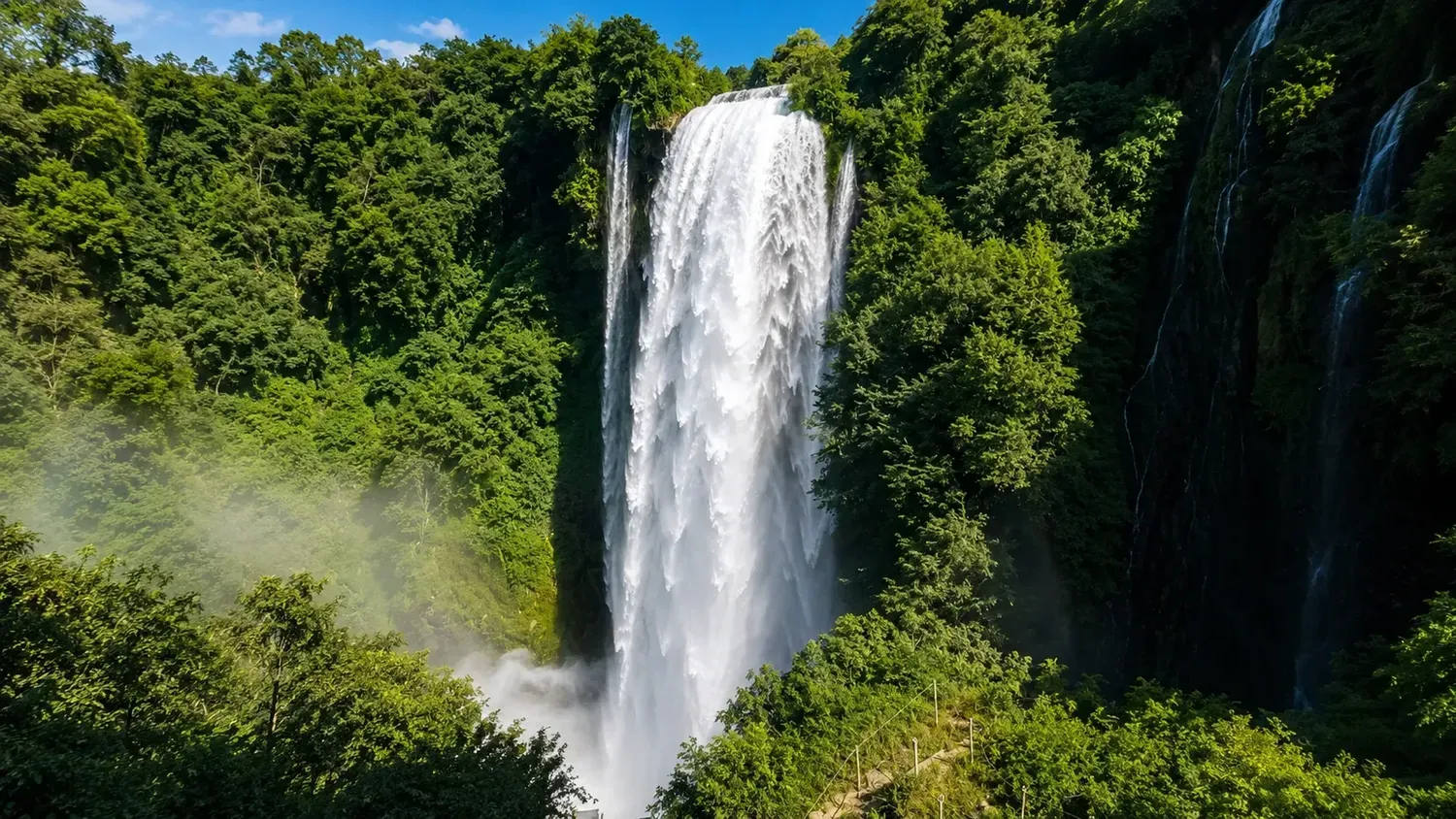
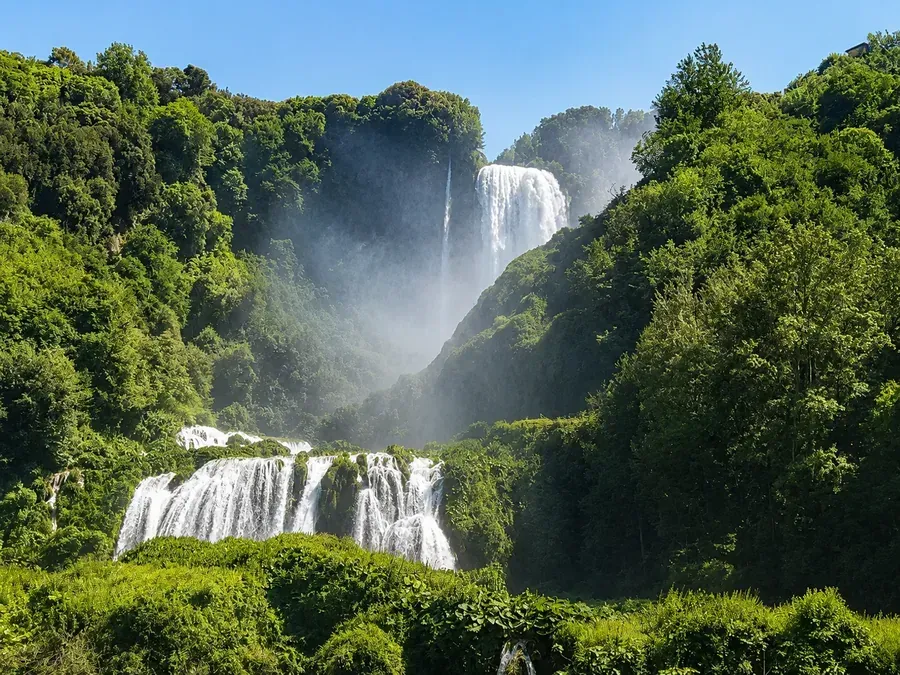
The waterfall descends through three major drops, with a total height difference of 162 metres.

The history and description of an extraordinary hydraulic work begun in Roman times and transformed over the centuries.
Discover its historyAn impressive setting that has fascinated travellers and artists over the centuries.
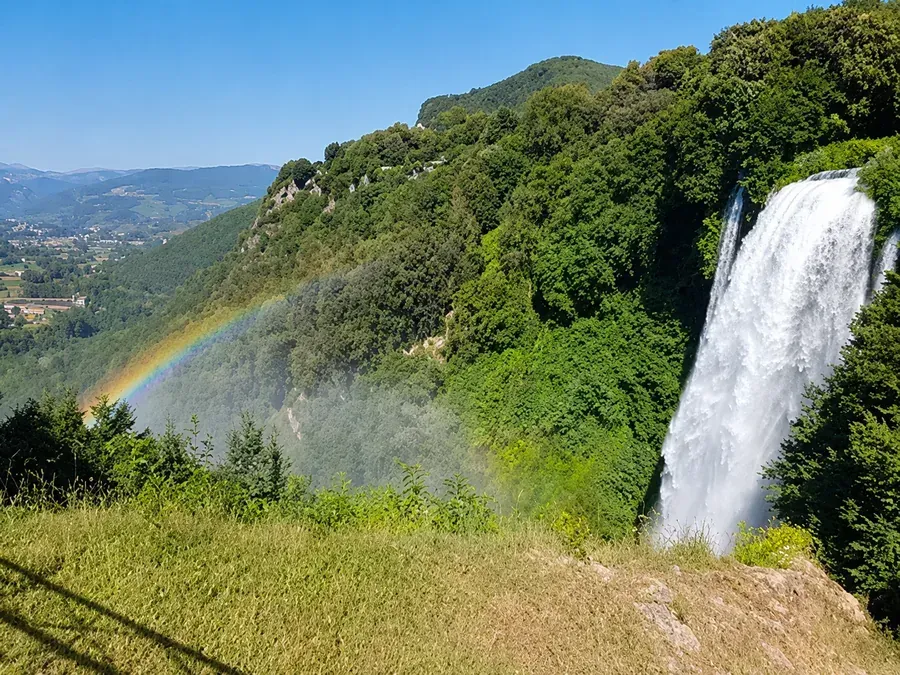
With its three drops and a total height difference of 162 metres, Marmore Falls offers a magnificent and unforgettable spectacle. It was one of the favourite destinations of Grand Tour travellers, and artists from different periods celebrated its beauty. Lord Byron is also remembered among them, having dedicated a famous ode to the waterfall.
Marmore Falls is a major man-made hydraulic work begun in Roman times. The waters of the Velino River were channelled into the Nera through a system of canals, while a network of paths leads to the different panoramic viewpoints.
Three main features summarise the historical description of the waterfall.
The waterfall descends through three major drops, with a total height difference of 162 metres.
The first major work dates back to 271 BC, when the consul Curius Dentatus ordered the excavation of the Curiano canal.
A network of nature trails leads to several viewpoints overlooking the waterfall.
From the first Roman intervention to the transformations that shaped the appearance and modern use of Marmore Falls.
The work commissioned by the Roman consul Curius Dentatus in 271 BC.
Marmore Falls was created by the Roman consul Curius Dentatus to reclaim the Rieti plain and free the valley from the marshland caused by the Velino River.
Curius Dentatus ordered a canal known as the Curiano canal to be cut through the rock, allowing the waters of the Velino to fall into the Nera River below. The purpose of the intervention was to make new land suitable for farming and settlement, irrigate fields and provide water for local communities.
The Curiano canal, however, could not completely contain the floods of the Velino. The waterfall reduced the marshland problem on the Rieti plain, but created other difficulties in the territories farther downstream.
The disputes between Terni and Rieti and the construction of a new canal.
In 1385, the people of Terni blocked a plan by the people of Rieti to build a canal as an alternative to the Curiano canal. They feared that an excessive flow of water from the Velino into the Nera could flood their lands.
The project was later resumed and completed in 1422 by the architect Fioravanti, commissioned by Braccio Fortebraccio da Montone. The new parallel canal became known as the Reatino canal.
Giovanni Fontana's intervention, inaugurated in 1601.
After several attempts, Pope Clement VIII commissioned the architect Giovanni Fontana to solve the problem of marshland on the Rieti plain, returning to the solution first adopted by the Romans.
The ancient Curiano canal was widened, its bed was lowered and its gradient increased to speed up the flow of water. A regulating bridge was also built to control the passage of the water and reduce flooding in the Nera valley.
The new canal, inaugurated in 1601, was named the Clementino canal. The intervention contributed to dividing Lake Velino into several independent basins, including the lakes of Ventina, Canale, Cor della Stella and Piediluco.
Images of the waterfall and a video showing the force of the water and the valley landscape.
From Andrea Vinci's project to the use of the water for energy production.
In 1787, the project by the architect Andrea Vinci, approved by Pope Pius VI, introduced a diagonal cut on the second drop and helped give the waterfall its present appearance.
From 1861 onwards, the waterfall began to be regarded not only as a means of land reclamation and water-system regulation, but also for its energy potential in connection with the industrial development of Terni.
Between 1873 and 1879, the municipality promoted the construction of the Nerino canal. Later, the power of the water helped operate the Arms Factory and the Terni Society of Blast Furnaces, Foundries and Steelworks.
A day trip to discover one of Umbria's most impressive landscapes.
When staying at B&B Il Terrazzo in Orvieto, you can reach Marmore Falls in approximately one hour by car. The route crosses the Umbrian countryside and the Lake Corbara area, making it possible to combine a visit to Orvieto with an excursion towards Terni and the Valnerina valley.
Before leaving, it is advisable to check the driving route, the water-release schedule and the access arrangements for the waterfall park.
Tickets, water-release times and parking.
An entrance ticket is required to visit Marmore Falls Park. Tickets can be purchased online or at the park ticket offices. Buying online allows visitors to enter without queueing at the ticket office.
Check prices and buy tickets on the official website
The park opening times and the water-release schedule change throughout the year. Before visiting, it is important to check the latest calendar, as the waterfall's maximum flow can be seen only during the scheduled release periods.
Check the official opening and water-release times
Several parking areas are available near the entrances to the park. The best choice depends on the entrance point, the viewpoint you wish to reach and the possible availability of the shuttle service.
B&B Il Terrazzo is a convenient starting point for discovering Orvieto and planning excursions to other destinations in Umbria.